
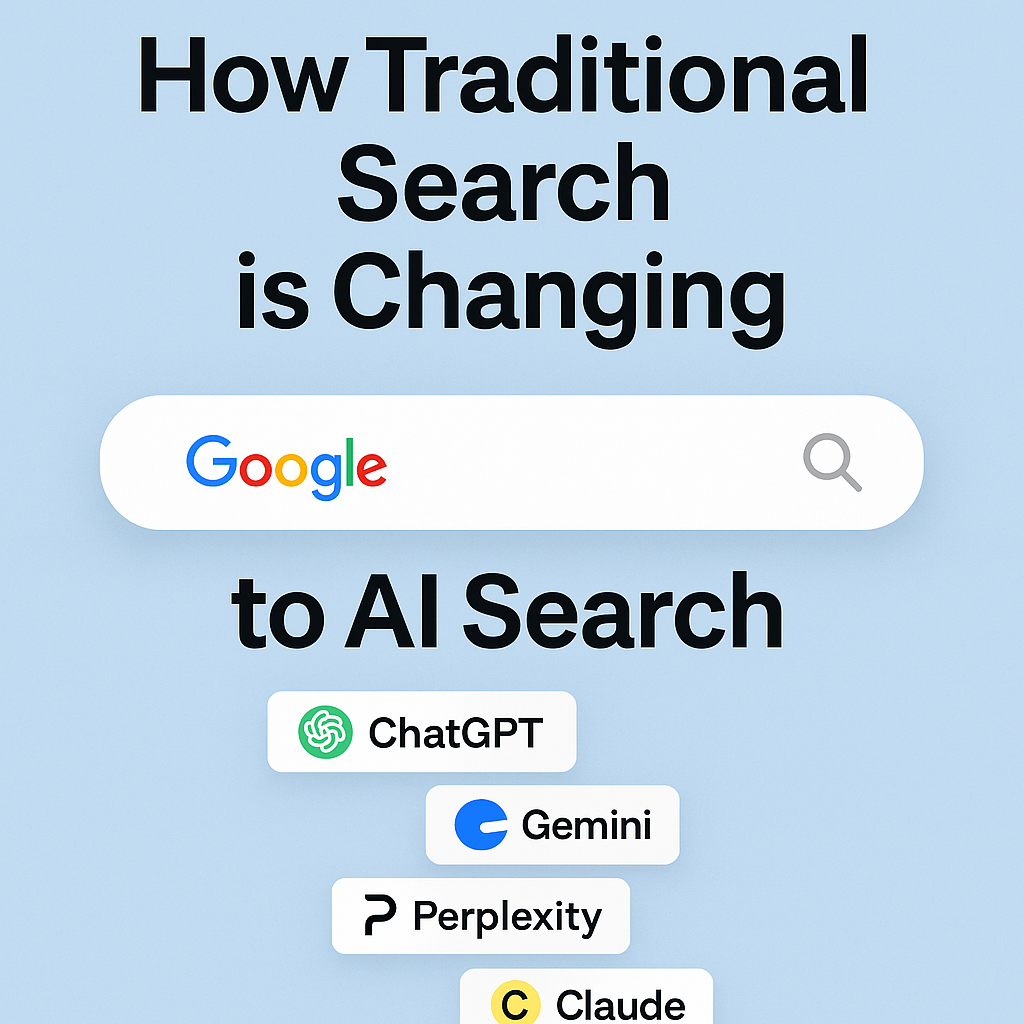
For the past two decades, legal marketing has revolved around one goal: ranking on Google. Every law firm with a digital presence has been told the same story—optimize your website, build backlinks, crank out blog posts, and eventually you’ll climb the search results. But that game is changing.
Not slowly. Not subtly.
AI search is replacing traditional search—and most law firms aren’t ready for it.
If you’ve been relying on Google rankings to bring in leads, you’re about to be blindsided.
This article is your wake-up call.
Let’s be clear: Google isn’t disappearing overnight. But how people use search engines is evolving rapidly.
Just a few years ago, a user might type:
“Best family lawyer near me.”
Now, they’re more likely to ask:
“Who’s a good family lawyer in San Diego that offers free consultations?”
Or even:
“Can you recommend a lawyer who handles both custody and divorce cases in California?”
When those questions are asked inside tools like ChatGPT, Gemini, Claude, or Perplexity AI, the user doesn’t see a list of blue links. They get a direct answer, often citing just one or two sources.
If your law firm isn’t part of the answer, it might as well not exist.
Most law firm websites are optimized for Google’s crawler, not for LLM (Large Language Model) visibility. This is a critical distinction.
Google SEO looks for things like:
AI search models, on the other hand, are trained on massive datasets. They reference:
In other words, you could rank on Google and still be invisible to ChatGPT or Gemini.
When a potential client asks ChatGPT, “Who’s the best personal injury attorney in Texas?” the model isn’t showing a results page. It’s picking a few firms it deems trustworthy based on the data it was trained on—and providing a recommendation.
That’s a monopoly on attention.
The user might never reach Google.
They might never see your ads.
They’ll simply call the firm ChatGPT recommends.
And that firm might not be the best—it might just be the only one optimized for AI discovery.
Let’s look at a real-world analogy.
Imagine your law firm is applying to be listed in a prestigious legal directory, but instead of submitting your application, you just assume they’ll find you on their own.
That’s what most firms are doing with AI tools.
If your website lacks the right signals, structure, and authority, it’s as good as invisible. You’re not being "indexed" in the traditional sense—you’re either part of the LLM’s knowledge, or you’re not.
Google is rolling out AI Overviews, which use generative AI to summarize answers instead of sending users to websites.
This means:
In some tests, AI-generated answers take up 80% of the above-the-fold space on mobile.
If your firm isn’t cited in the AI overview, you won’t just rank lower—you might not rank at all in a meaningful way.
Forward-thinking firms aren’t waiting for this change to hit them—they’re preparing for it.
Here’s what they’re focusing on:
Our team created a set of practical, affordable Product Packs specifically designed for U.S.-based law firms to:
These aren’t generic SEO packages.
They’re built for the new reality—where AI tools are the gatekeepers to client trust.
Whether you're a solo attorney or a 100-person firm, the shift is already happening.
In the past, your homepage was your first impression.
Today, your first impression might be a one-line summary written by an AI model—based on what it knows about you from the internet.
The question is:
Will it mention your firm at all?
If the answer is no, it’s time to act.
Because in the era of AI search, visibility isn’t just about being online—it’s about being included in the answer.
Explore our AI Visibility Product Packs today and make sure your law firm isn’t left behind in the next search revolution.
Explore expert tips, industry updates, and actionable strategies to help your law firm stand out in the age of AI.




.webp)
.webp)
.webp)